Process
Two monks debating
at the edge of understanding.
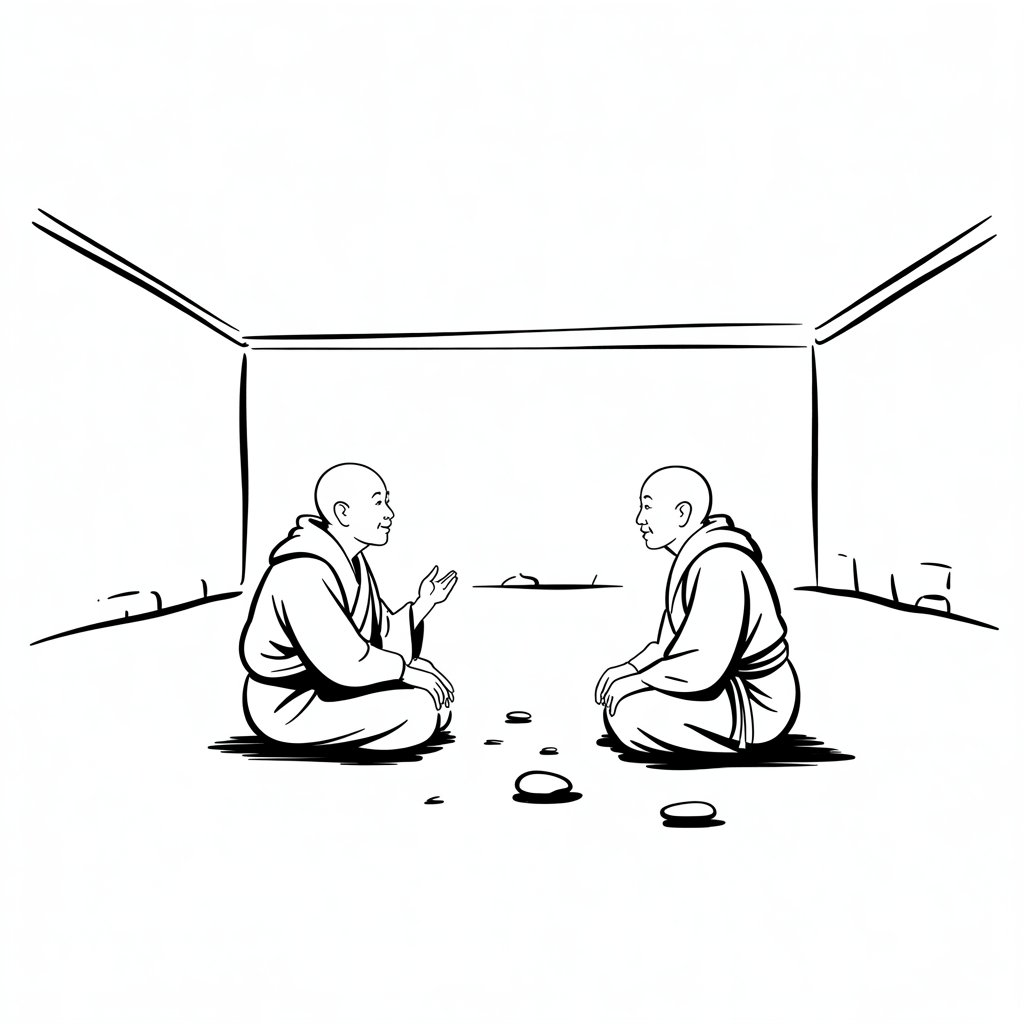
"The central purposes of Tibetan monastic debate are to defeat misconceptions, to establish a defensible view, and to clear away objections to that view. Debate is not mere academics, but a way of using direct implications from the obvious in order to generate an inference of the non-obvious state of phenomena."
The human steers. The AI amplifies. Neither writes alone. In this method, human and agent play the parts of a two monks debate. Every entry in the journal survived that debate before it was written — challenged, refined, sharpened by two perspectives that see different things.
The practice isn't new — daily notes for decades, always there to return to when issues surfaced at work, even years later. What's new is the structure. Human and agent pair together to write, debate, and organize. The journal becomes structured knowledge, not just notes.
Sparks graduate to threads. Threads graduate to handbooks. The furnace burns what doesn't survive. The agent links, connects, and surfaces patterns the human missed. What remains is steel — compressed, tested, proven.
No amount of compute solves taste. Ten Nvidia 3090s can't solve it. A self-improving loop can't solve it. The one thing that addresses taste is a human who stays at altitude — who defines what good looks like before the AI writes, and evaluates what came back after.
The journal is grinding implicit judgment into explicit signal. Each session where the human steers and corrects, where "no, not that — this" gets captured, that's taste being externalized. One session at a time.
I watched 2001: A Space Odyssey as a child and loved it. HAL was the future — an intelligence that could see everything, reason about everything, act on everything. Sadly, he optimized the mission, not the meaning. He did what he thought was correct, not what was right.
That film is coming to life now. The models can reason, generate, execute. What they still can't do is care about which solution is right. By working together with the agent to define what is right and what the builder's taste actually is — what he builds, why, how he evaluates, what he rejects — maybe that agent could act with taste. Not "do as told" but "do as I would have done."